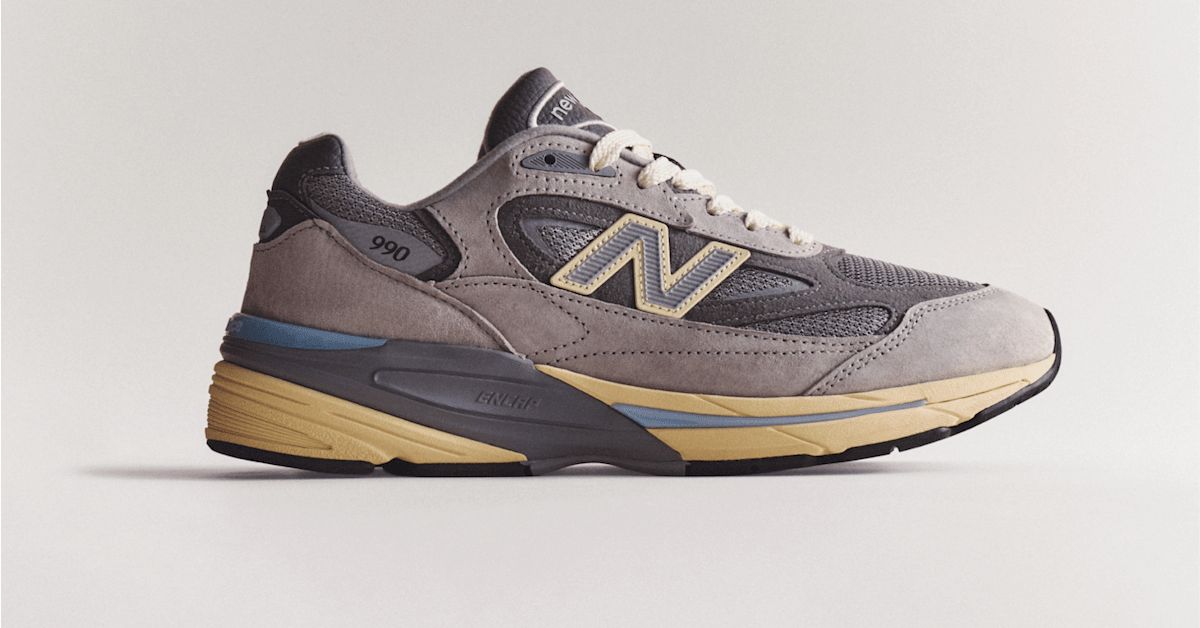

New Balance has another grey sneaker, and it might be their best one yet. The internet is in love with the 990v7. As the name suggests, it’s the seventh edition of the 990, a premium grey suede running sneaker that debuted in 1982 and was made in the USA. It was the first $100 sneaker ever. That’s roughly $350 today. It became the defining image of New Balance. Nearly 45 years later, the 990 has changed. The upper has more pieces and is faster looking. And there’s Fuel Cell technology in the midsole. But in many ways, it’s stayed the same.
New Balance says the 990 is worn by “super models in London and dads in Ohio.” But it’s also worn by residents of the DMV and Philadelphia and has become a sneakerhead staple in recent years. The v7 is a grey 990, but it’s also different. It has a light blue, almost grey, piece that runs through the midsole and heel. And the midsole is an aged cream. It’s equal parts new and old. It debuted as a miniature image on a large white billboard. Rosalia hit the streets in theme before Joe Freshgoods posted an on-foot shot that had fans declaring the shoe’s greatness.
But what’s the story behind the 990v7? It’s designed by Jean Khalife, an industry veteran who worked at Adidas during the Yeezy era. He’s a man who pays attention to detail. He grabs from the past and launches it into the future. And that’s what we did with the 990v7.
I spoke to Khalife about the 990v7 before its November 6 release about the risks he took with the shoe, and how hard it was to make a new classic.
This interview has been lightly edited and condensed for clarity.
Complex: How long did it take to design the sneaker?
Jean Khalife: I think when it comes to a 990, because of the amount of attention and the amount of testing we want to do on that shoe on wear test, it takes always between two and a half to three years to do. So, it’s a long labor of love to craft a 990. It’s one of those where we tested it and validated it as much as some of our high-end performance products.
What would you say the biggest change in the V7 is?
The biggest change—I think there were a lot of elements of novelty in that shoe, and I’m sure people already started to pick on them on some of the pictures that’ve been shared. I think the biggest change is two things. One of them is really functional oriented. It’s a franchise that was encouraging performance. So the new piece of novelty is that floating TPU shank that adds a little bit of stability and is complimentary to the Encap system that everyone’s known and loved for years. So it’s like having that TPU shank that crosses the midsole that you see—that blue piece that crosses the midsole is one key new element. Just because we have a new, softer Fuel Cell, softer foam, it was a way to balance out cushion and stability with that new shank that is transversal to the entire midsole. So it’s like the midsole architecture is very new, even though at a glance it looks like the classic 990 the way the different foam and components are plugged together, but that TPU shank is one element of novelty.
The other thing that is very new on the V7, and I’m sure people are going to pick that even more once it’s released and they have it on hand, is the refined silhouette. We worked a lot to have a silhouette that feels like a luxury item—a luxury running item—and is definitely more tailored and tapered against the foot versus maybe some silhouette that we started to have throughout the years that were maybe a little bit more bulky and bubbly.
How hard do you think it is to please New Balance fans with the new 990 design?
It’s 45 years of 990 next year. So you’re working toward a franchise and a legacy that is maybe one of the oldest franchises in running in the industry. So you want to do good for it; the pressure is on. And then when it comes to the people, I think that’s one of the biggest challenges. You recognize right away that the demographic that loves the 990 is so wide.
And some people love the 990 for the functional aspect, for the performance. Some people like the 990 for the more lifestyle and fashion attributes that it has. So it’s like the big thing is to go back to the roots. That’s what we’ve done. We get back to what the original 990, 1982 represented for people. It was the pinnacle of performance running with high-end craftsmanship. And we just wanted to look back at these blueprints and dust it off and do it with the 21st century way of manufacturing and technology and innovation, and wrap it still with a lot of familiarity and a lot of material that people know and love and want to see on the 990.
How big of a risk was it, do you think, putting that light blue line through the shoe?
It’s a calculated risk for two reasons. One, because we wanted it to be fully integrated into the iconography of a 990. It’s one of those shoes, we have a trade dress for it. We know what a 990 should feel and look like. And one of the mantras that I had during the project was this idea of memory from the future. So it’s like the idea that we balance the novelty with the familiarity. And so the end goal was that when people see the new 990, they recognize instantly that it’s a 990 because of the different shape and the design cuts that we have. The closer they get, they realize it’s the new one. So it’s this idea of paradox between memories of the future. It’s progressive, but it has elements of familiarity. Now, that blue piece is integrated in the midsole as a new way to talk about performance throughout that franchise, which is always very close to performance running and always has been.
And it was a risk, and it’s not just because it has a real function. I think one thing we wanted to make sure, and it’s something we do for New Balance in general, it’s no gimmick. That thing is not there to be decorated. That thing has a function, a supportive element.
When you designed the shoe, did you take into any sort of consideration that it would be good for collaborations?
Yeah. I mean, I think that’s one thing that obviously New Balance is very known and strong at, and that’s a part of the balance that I was talking about. It’s like I wanted to bring full immersion into the blueprint of what makes a great 990 in terms of performance attributes, the ratio between cushion and support, and be very clinical with that and very scientific. But I think the trait of a great 990 is a shoe that speaks also into the fashion side and the streetwear side and into a broader audience. And of course having conversation with the lifestyle team, the energy team, understanding also some of our key collaborators, we wanted to make sure that the shoe could be an icon on its own, but also potentially a great canvas for other collaborators to express themselves with. So this has also been a part of the design process to balance as well.
Read the full article here