


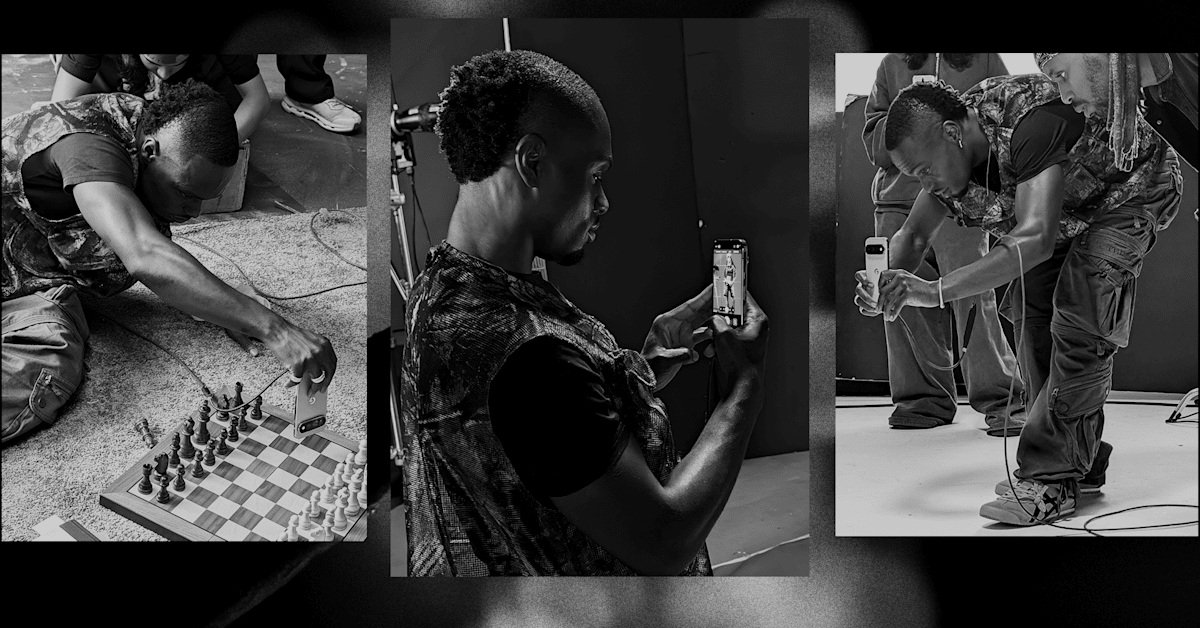

Culture in Focus is a collaborative project that invited three top photographers from Google Pixel’s Creator Labs program to shoot the leading fashion trends of the past 11 years through the lens of the Pixel 11 Pro, the line’s best camera yet*. Dana Scruggs, Justin French, and Campbell Addy each chose to shoot trends that personally resonated with them, including everything from 2016 Rockstar Lifestyle to 2026 Urban Adventurer. Here, we interview each photographer about their craft, process, and shooting fashion editorials on Google Pixel 11 Pro without having to tote pounds of gear around. In the third installment of the series, we chat with Campbell Addy.
They say what goes around comes around, and nowhere is that truer than in the world of fashion.
Trends emerge, blow up, dominate the culture for a hot minute, before fading into obscurity—or so we think, until they re-enter the zeitgeist like they always do, pleasantly blindsiding those who were there for their first iteration and introducing nostalgic style codes to the newer generation of fashionistas. And sometimes these trends catch fire and grow bigger than they did the first time around, fueled by modern technology, the vast reach of social media, and a new generation of boundary-breaking creatives who refuse to play by the old rules, pushing every aesthetic past its limits.
Campbell Addy is one of those creatives.
Born and raised in South London, the British-Ghanaian artist and photographer has become one of fashion’s most influential imagemakers. Addy’s work is rooted in his deep commitment to representation, intimacy, and narrative depth. After graduating from Central Saint Martins in 2016, he wasted no time in disrupting the industry’s status quo, founding both Niijournal, a London-based biannual arts publication, and Nii Agency, a diverse casting and modeling agency—each dedicated to celebrating Black visibility, queer identity, and inclusive beauty.
“I don’t try to pinpoint my work to a single aesthetic; I prefer to pinpoint my work to a single ethos,” he tells Complex. “Just go out there and tell your story.” This distinct approach is the reason Addy has been trusted with the honor of capturing cultural icons such as Beyoncé and Naomi Campbell, and why he’s earned a string of prestigious accolades—from being named among Forbes’ 30 Under 30 to receiving the British Fashion Council’s Isabella Blow Award. His photography isn’t merely about taking pictures, it’s about building safe spaces where human authenticity and textural nuance are the stars.
For its Culture in Focus campaign, Google Pixel issued the acclaimed photographer a challenge: document four pivotal shifts in modern style spanning 2016 to 2026, using the new Google Pixel 11 Pro as his camera. From the functional fortitude of 2018’s Construction Couture and 2021’s rebellious Rebirth of Baggy, to the relaxed finesse of 2023’s Upscale Streetwear and unapologetic, blinged-out resonance of 2025’s Bedazzled movement, Addy was tasked with returning the defining visual language of each era to its former glory through technological innovation and organic storytelling.
Using a smartphone as your main camera might intimidate some photographers, especially those uninterested in budging from traditionalist values, but Campbell Addy embraced the opportunity with open arms and an open mind, excited at the prospect of challenging what modern photography can look like. Recalling what it felt like to be armed with nothing but the Google Pixel 11 Pro on set, Addy remembers asking himself, ‘Am I even working?’ But as soon as he tapped into the phone’s capabilities, any lingering doubt vanished. “It felt like I was straight to work,” he says.
On set at Broadway Stages in Brooklyn, New York, Addy moved through the four distinct eras with calculated precision, turning the Pixel 11 Pro into a direct extension of his artistic vision. Armed with a 50MP RAW capture system, an advanced 48MP telephoto lens**, and the nuanced color rendering of Real Tone, he pushed the smartphone to mirror the depth and dynamic range of a traditional heavy-duty camera rig. Dialing in manual controls right from the viewfinder—adjusting shutter speeds, deepening shadow fall-off, and setting custom photo styles—the award-winning artist captured the tactile grain of raw denim and the high-contrast highlights of rodeo rhinestones with immediate, in-camera perfection.
While impressed with the smartphone’s fluid functionality and easy-to-use advanced settings, Addy also points to the bigger picture, highlighting how the Google Pixel 11 Pro levels the playing field, democratizing the art of image-making so that anyone can share their story.
“I think the accessibility of a smartphone like Pixel allows so many communities that otherwise might not have access to big cameras to express themselves,” he says with a smile, genuinely curious at the prospect of seeing what the next generation of artists create.
With that, he urges any budding photographers to challenge themselves: “You now have the same tool I do, so go capture your style.”
Talking to Complex after the shoot comes to a close, Campbell Addy opened up about his creative process, navigating personal memories across his four designated eras, and sharing how the Google Pixel 11 Pro helped him turn nostalgia into the art he loves.
For this campaign, you were tasked with capturing four distinct eras of style. How did you interpret those cultural shifts through your own visual language?
Between the styling, set design, makeup, and lighting, we all came together to focus on the nuances. It was about the nuance of an eyeliner, the nuance of a hairstyle, or the exact way a hemline fits on a Baggy look compared to Construction Couture. It’s those micro-details that ground each era and make it feel authentic.
How did that focus on detail inform the lighting and camera work on set
When it came to lighting and capturing the shots, I kept coming back to timeless photography. If you try too hard to make an image look “period,” you end up trapped in an era that feels artificial. So we shot everything timelessly, letting the nuanced elements of the set, makeup, hair, and styling push you into those different worlds naturally.
This shoot puts the Google Pixel 11 Pro front and center as your main lens. What was it like stepping onto set with a smartphone, and what surprised you most about using it?
There are various things I usually have to outsource when I’m shooting on a big set, but with all the capabilities the Google Pixel 11 Pro has, it made my day a lot easier. It meant that I could concentrate on the photo and play around with it on my own terms without having to troubleshoot with others. Also, it’s super lightweight. I wish all cameras were this light—it really does damage your shoulders working with big cameras for eight hours at a time.
2018 marked the rise of Construction Couture, where workwear shifted from functional necessity to high fashion. What was going on in your own life and career during this time, what were you wearing, and how did the set evoke personal memories from that era?
That’s actually the year I got signed as a photographer, and it’s quite funny because I was a workwear guru. In 2018, I loved old Japanese workwear and dungarees. I lived in dungarees. I literally lived in Construction Couture—it just wasn’t as fancy as what we shot today. I had black Carhartt dungarees, black Carhartt trousers, and a brown Carhartt denim jacket. Even my dog had a matching Carhartt harness, because that’s all I lived in at the time.
Your dog had a Carhartt harness?
Yeah, he had a whole harness. It matched my dungarees. His name was Wolfgang, named after the character in Sense8.
The Construction Couture set featured pops of high-vis orange against dark, industrial textures. How did the Google Pixel’s color accuracy and dynamic range handle those hyper-saturated highlights alongside the raw set materials?
The Real Tone processing kept the overall environment looking natural to the eye, while applying the custom Looks allowed me to punch up specific colors in a way I’d usually save for post-production. I really wanted the oranges to pop off the set, because the dominant backdrop was this yellowish-beige wood chip alongside white technical drawings. On the color wheel, I wanted those warm yellows and high-vis Carhartt orange tones to jump out first. The Google Pixel holds up remarkably well with that kind of dynamic range—it gave the garment real punch without blowing out the highlights.
Were there any specific camera features that proved essential for capturing that aesthetic?
The RAW capture. This is something I tell everyone using the Google Pixel: turn on the RAW function. Even though the built-in presets are great, the RAW file holds so much data and bandwidth for color grading—it’s like shooting Log video. The highlights on the white technical drawings weren’t blown out, and the high-vis jacket didn’t overwhelm the frame. I was genuinely surprised by how well it held up. It also makes my efficiency on set so much faster because I’m not standing there having my team flag part of the garment with half-bleached muslin—you can dial everything in right inside the camera.
Shooting in RAW generates massive files that can consume storage and impact processing speed. Does that trade-off ever make you hesitant to rely on it on set?
For an everyday user taking quick snapshots, turning on RAW can definitely take up more memory and slow down the phone’s processing. But for editorial work, it’s non-negotiable because it preserves all the data within the frame. You don’t have to worry about the whites blowing out or the blacks clipping into crushed shadows, plus you end up with a rich file you can actually print at a decent size. We shot today at 50 megapixels, and I was just sitting there like, ‘Wow, this phone is seriously powerful.’ The Google Pixel has come a long, long way from when I first started using it four or five years ago.
The Rebirth of Baggy trend in 2021 signaled a major generational reset, rejecting years of slim-fit dominance. What did that cultural shift toward volume and oversized proportions represent to you?
I don’t dress as baggy now, but when I did, that silhouette gave me so much confidence. For today’s shoot, we had a female model, and the first person I thought of was Billie Eilish. She’s the modern pop icon of that younger generation, and her approach to clothing was so brave because she chose to dress in a very specific, unapologetic way. There’s a confidence and a boyishness to it. There’s a roughness, but it’s beautiful. Whenever I speak to the younger generation today, especially young women, I’ll ask them, ‘Why do you like dressing so baggy?’ And they’ll tell me, ‘I don’t feel like I have to be sexualized. I don’t feel like I have to conform to how the female body is supposed to be draped in fabric.’ That’s kind of badass!
How did you bring that same energy and mindset into prompting your model for the Rebirth of Baggy setup?
When I saw we had a female model, I said to her, ‘Okay, you are a female rapstress. I’ve come to your studio in the ‘90s, and you’re just reeking of confidence—eye contact straight to the camera, and pure attitude in how you hold yourself.’ And she really fell into that character. That’s how I feel when I see a baggy silhouette, because you need a real sense of bravado to carry it. You can’t be shy and meek in a fab, huge, baggy look. I also love that you don’t instantly know what someone looks like underneath the clothes—I love the anonymity of it.
Denim relies heavily on subtle details—distressing, contrast stitching, and wash gradients. How did the Google Pixel’s telephoto lens and manual controls handle those fine fabric textures?
It came down to the camera features and using proper lighting. I went straight to Shutter Priority on that setup, shooting on a white cyc to make sure we illuminated every weave. From standard telephoto up to 5x zoom, it captured more than enough detail. Light is critical regardless of what tool you’re using—whether it’s a massive DSLR or a Google Pixel—and it held up remarkably well. I’m not gonna lie, those were the easiest garment detail shots I’ve ever taken. In fashion photography, you’d be surprised how long it usually takes just to achieve focus with heavy, specialized lenses. Being able to drop the shutter speed and pull in more light right on the phone made the whole process effortless.
Did that efficiency give you more room to experiment creatively with the detail shots?
Absolutely. Because it was an editorial space, I had the freedom to personify my feelings into those close-ups. For some of the shots, I deliberately let a long exposure take place to introduce a little bit of motion blur. I don’t believe every single image has to be pin-sharp and hyper-detailed to convey an idea or an emotion. Sometimes that intentional softness tells a much deeper story.
Moving to 2023, Upscale Streetwear marked a shift from loud hype logos to quiet luxury and rich textures. How did your own photographic style evolve as fashion embraced this trend?
Twenty twenty-three is when my approach to photography became a lot more timeless. That was actually the first setup we shot today, and because it’s from a recent era—one I’ve lived through vividly—I thought carefully about how to capture it without dating it. It was all about color harmony: rich skin tones, muted browns, and beige, offset by primary pops like a red, green, or baby blue. That period forced me to mature as an artist. I moved away from chasing fleeting trends and started focusing on legacy-led projects. I understood who I was as a person, and I wanted the character on set to reflect that same quiet confidence.
How did you translate that idea of “quiet luxury” when directing your model on set?
I gave her a very specific mindset: ‘You’re at home playing chess, reading books, choosing vinyl over CDs. You move a lot slower.’ Everything in that room might look simple on the surface, but it carries a luxurious essence—whether it’s the fabric or the design. It felt like a reflection of my generation right now: we want things that are elevated and timeless, not gaudy or loud.
Why do you consider collecting vinyl a form of modern luxury?
Because vinyl is a deliberate choice. CDs feel retro, but vinyl is a commitment. It takes up real estate in your home, and in our generation’s economy, space is at a premium. But it’s an art form—from the album artwork to the ritual of playing it. Collecting vinyl means investing in a turntable, good speakers, and a dedicated setup. You’re curating your space around an experience, and that intentionality is the exact definition of quiet luxury.
The Upscale Streetwear aesthetic relies heavily on rich, warm, and elevated tones. How did Google Pixel 11 Pro’s built-in Camera Looks and custom photo styles*** help you establish that exact mood in real time?
I always go straight to the Shadows setting because deep, rich shadows are central to my artistic style—they give an image instant depth. When you combine that with the Editorial or Velvet Camera Looks, it neutralizes the white balance ever so slightly so the browns and reds appear true while deepening the blacks. Right away, the images looked stunning. On set, our model had these fabulous pleated trousers, and applying those built-in settings allowed you to see exactly where the fabric fell and where the shadows landed. It brought out a quiet luxury in the trousers themselves—you could see the crispness of the pleat against a deep, dark falloff.
Using the chess set from the 2023 setup as a metaphor—which fashion piece from that era is the King, and which is the Queen?
Oh wow, that’s tough. For the King, I’d say adidas Gazelles—a solid, everyday staple. But the Queen has to be something that needs to be protected, something a bit more rare or controversial. So for the Queen, it’s definitely the [Maison] Margiela Tabi—specifically the two-inch heel pump.
The heel version of the Tabi is such a specific choice—what made that shoe stand out so much during that period?
It was everywhere, but it wasn’t normalized yet. It was unisex, but you didn’t think that little pump would hurt your feet as much as it did—my soles are still recovering. I remember buying them at Margiela in Manhattan with two of my friends. I walked past the Guggenheim wearing them and people were giving me dirty looks like I was a devil worshiper [laughs].
2025’s Bedazzled trend celebrates maximal self-expression—merging Western wear and urban streetwear with rhinestones and heavy embellishment. What does this eclectic mix of durags, cowboy boots, and crystal denim represent culturally?
For me, it represents a powerful blending of gender signifiers. Bedazzling and glitter are traditionally coded as feminine, while rough denim and heavy silhouettes are coded as masculine. Fusing them creates this soft, hyper-fabulous, yet masculine energy. My reintroduction to it was in the summer of 2024 in Atlanta. I was enamored by the fashion—guys buying skinny jeans two sizes too big, stitching extra denim to the hems so they gathered over cowboy boots, and manually bedazzling every single crease. It’s this incredible expression of craft and identity.
How did that Atlanta energy translate when directing the model for the Bedazzled setup?
Ironically, the model’s name was Sparkle. I gave her a very specific character reference: ‘You are Tyra Banks in Coyote Ugly, but set in 2025.’ That was the exact energy on set—pure attitude, confidence, and high-octane glamour mixed with edge.
How did you handle the complex lighting dynamics and reflective surface highlights on the Bedazzled set?
Because every part of her outfit—from her trousers, to her boots, to her nails—was blinged out. I imagined the sparkles to look like floating stars. So in some of the images, I intentionally dialed down the exposure and used a slower shutter speed to stretch out the light refractions. It created this amazing effect where the model looks like she’s frozen in time, but surrounded by these trails of moving light—almost like the video for Madonna’s “Ray of Light.” Dropping the light levels made the atmosphere feel heated, and a little more sweaty.
Beyond static lighting setups, how does a feature like Magic Capture change the dynamic when working with models in motion?
It completely changes how you direct. When people stand still posing for too long, they can get self-conscious. Keeping someone in continuous motion allows you to capture the absolute best, most authentic frame. We focused on static, low-light poses today, but having the Magic Capture tool in your back pocket for fast movement is huge.
How much do you rely on tech and devices in your daily workflow, and how does the Pixel fit into that routine?
If I’m being very transparent, a year ago would have been a different answer. A year ago, I was a bit of a Luddite, I’m not gonna lie. I was like, ‘I don’t really like technology, it scares me. Why do I have to learn these things?’ But then, I’m a gamer. I like the ease. I travel a lot, so I need to have things on me that work. Like, say all of my kit is at home, I need to have miniatures—like skincare, I need minis for my maxis.
Having a phone like Pixel in my pocket on set allows me to troubleshoot ideas without having to set up four different lights and try them out with my team. Also, when I’m in my studio or a hotel, I can create a baseline image for my creative team and go, ‘Hey, I want to try this.’ I literally did it yesterday to my creative assistant, Lucas. I was just fiddling with it in the hotel and went, ‘Wait, I want to try this out later.’ Before, I’d have to draw it, paint it, or be on set and remember it to try it out. So it’s made taking my ideas to reality a lot quicker. Is that a good thing? Who knows—because I might be annoying the hell out of my team sending them pictures like, ‘Let’s do this! Let’s do this!’ So for me, it’s great. I don’t know if my team likes it, though [laughs].
The theme of this campaign challenges creators to “Ask More From Your Phone.” As a fashion photographer accustomed to high-end studio setups, how does having those professional capabilities inside a smartphone shift expectations of what mobile tech can do in a studio space?
It comes down to accessibility. I’ve been very blessed to have gone to university to study photography, but if I were born in a different place or time, I might not have had access to the same technologies. I think the accessibility of a smartphone like Pixel allows so many communities that otherwise might not have access to big cameras to express themselves. You get to learn the fundamentals—ISO, shutter speed, manual exposure—right in your pocket. It lowers the barrier to entry for the next generation of creative talent, which is huge.
From a technical standpoint, what was it like dialing in those manual controls and custom settings on set?
I’m a geek when it comes to fiddling with tech. I loved having full manual control—switching between shutter speeds, playing with color warmth, textures, and custom looks. Before even snapping a frame, you can spend time dialing in the exact mood. When I was using the slower shutter speed on set, it took me right back to university, calculating light and exposures in my head. I don’t try to pinpoint my work to a single aesthetic. I prefer to pinpoint my work to a single ethos—and having that level of granular control inside a phone genuinely blew me away.
How do you feel tools like the Google Pixel ultimately empower the broader creative ecosystem?
It empowers creators to think much more instinctively. I’ve been on big sets where you’re using huge cameras, everyone’s staring at a monitor, and the pressure is intense. People don’t always realize that you’re still just a person trying to figure something out, warming up to the idea. When I first got into photography, a photographer named Eloise Parry told me, ‘It’s not about the camera you use—it’s your tool. Whatever your tool is, just go out and use it.’
Having a phone like this completely democratizes the playing field. If I decide I solely want to shoot on a Google Pixel, no one can tell me otherwise. Before, clients would bombard you with technical excuses: ‘Oh, we’re not sure if it can reach the quality.’ Yes, it can. ‘We’re not sure it can handle the frame rates.’ Yes, it can. The Google Pixel meets all of those technical standards now, but it doesn’t feel pretentious. If I brought four different heavy camera rigs to set to experiment, people would be like, ‘This guy’s a bit woo-woo, he thinks he’s an artist’ [laughs]. But using a phone feels lightweight and personal. It allows you to focus purely on the craft. I’m a huge believer in letting people tell their own stories, and this gives younger photographers the freedom to do that—and when I say “younger” photographers, I mean timeline, not age. You could be 94 and just starting out, and you’re still a young photographer.
Out of the four style eras captured today, which setup resonated the most personally?
Honestly? Upscale Streetwear resonates with me, because I’m in the present, and that trend still continues today, and I’m thinking about where I am in my life right now. Nostalgia would’ve told me to pick one of the older eras, but where I’m sitting in my career, I think about timelessness a lot. I try not to view trends in a fleeting or cyclical way. Shooting Upscale Streetwear reminded me of the film Malcolm X, with Ruth E. Carter’s incredible costume design—those suits and those hemlines. It’s a specific type of sartorial style that adds to the timelessness of fashion, linking modern street culture back to classic suiting and tailoring. When I’m a granddad, that’s probably how I’ll dress to go pick up my grandkids. Some people might be a bit snooty about recent fashion shifts, but years from now, we’re going to look back at this period as a true turning point in style.
When viewers experience the Culture in Focus series, what do you hope they reflect on regarding style, memory, and time?
I hope they see the timelessness of it all. But I’m also kind of a troll—I want some people to look at it and go, ‘Hey, that’s not how my era felt!’ And then I implore them to take their own phone out and capture their version of it. We live in a digital age where things enter our orbit and disappear so quickly, and without a visual reference, we lose those memories. It’s like William Eggleston—he just captured his day-to-day life, and at the time it felt normal, but now you look back and go, ‘Wow, what an era.’
When they’re live, you can see Campbell’s Culture in Focus shoots here: 2018 Construction Couture, 2021 Rebirth of Baggy, 2023 Upscale Streetwear, and 2025 Bedazzled. Then, check back to watch the BTS video from his shoots here.
*Comparison is to other Google Pixel phones only.
**Reflects megapixels for camera sensor. Camera image resolution output may be less when using default settings.
***Addy used Google Pixel 11 Pro’s built-in Camera Looks for photographs, which then received treatment with 3P tools in post-production.
Read the full article here

.jpg "5 Best Brightening Deodorants For Your Underarms, According to Dermatologists")

