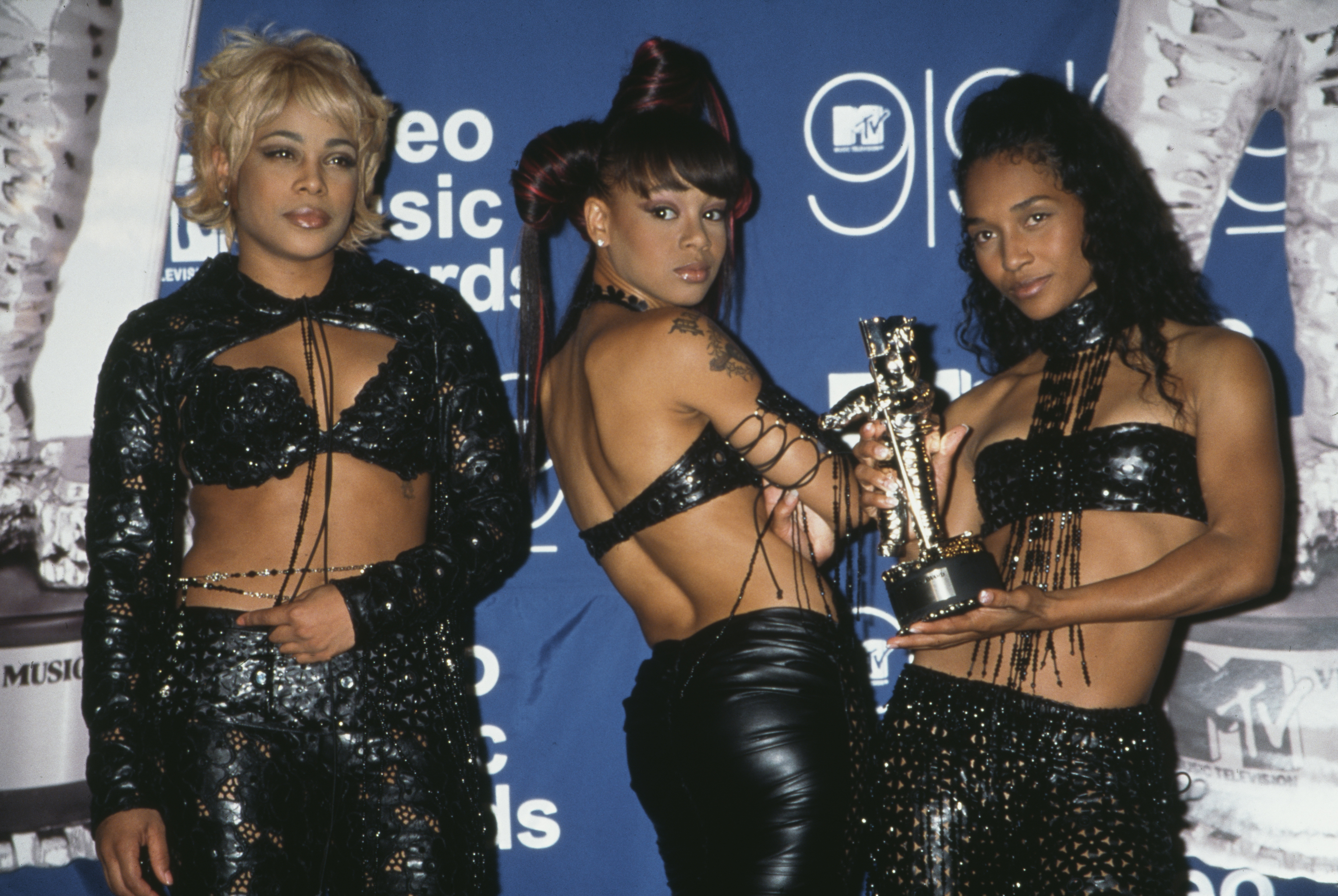
Hairstylist Marie Brown crafted signature looks—across music videos, award shows, and red carpets—that defined TLC’s crazy, sexy, coolness. She cut T-Boz’s hair since the singer was 15. She introduced the trio to Pebbles and L.A. Reid, who went on to sign them. And she was an accomplice to a sticker tagging spree of luxury cars on Sunset Boulevard with Tupac and Left Eye. It’s fair to say that she was equal parts genius and family behind the iconic trio.
“The image was just as important for the label as the music,” Brown shared. She crafted an arsenal of distinct looks for each member and a visual identity that was unique and singular.
Brown recalls Lisa “Left Eye” Lopes being one of the most involved and experimental members of the group when it came to her looks. She reminisced about the late, beloved rapper as an experimental, sharp, and spontaneous spirit. “She understood hair pieces,” Brown told Complex. Alongside Brown,Left Eye erected an aesthetic reproduced and copied to this day.
Chilli and T-Boz, however, preferred more consistency. Chilli favored long curls (occasionally accented by small ribbons) with Ampro and Lottabody set baby hairs. T-Boz stuck to her signature blonde, cropped look with sideburns, which Brown (who always liked movement) cut spontaneously on the set of the “Creep” music video.
Armed with extensive hair boards, endless prep, and memories to last a lifetime, Brown spoke to Complex about crafting the signature looks that defined TLC’s career.
How did you connect with TLC?
I had met Tionne [Watkins], T-Boz, when she was about 15. I had a hair salon and she was coming into Kroger’s. I stopped her, gave her my card, and told her she was a star. Lord knows, I didn’t know it was going to be that kind of star, but she was.
She ended up coming to me [for hair]. I did her hair on and off from the time she was 15. Eventually, I took her to LaFace Records, and that’s how she ended up getting signed.
How did you bridge that connection?
I was Pebbles’ [Perri McKissack Reid] in-house hairstylist in Atlanta. When Tionne had a group, she brought them to me. Chilli [Rozanda Thomas] wasn’t the original [third] girl. It was a girl named Crystal. They had a great look. Left Eye[Lisa Lopes] caught your attention right away. So I went and told Pebs there was a girl group I would love for her and L.A. Reid to see, and they were excited about it. I set up a meeting, they liked them, and they liked their visuals. From there on, we did photo shoots with ’em, shopping, basically artist development.
This was the era of girl groups. We had Destiny’s Child, Spice Girls, and groups like Blaque. How did you approach giving each of the girls their own distinct look?
It’s me wanting everybody to look different. I always just looked for a little flare to make ’em understand the character of the song. I approached it almost like you would a movie script or a storyboard. A lot of times, before I even did anything, I would go through Vogue and Cosmo to see if anything inspired me. I might put 10 things together to get one look. I was young and creative.
Would you sketch, or was it mainly collaging clippings together for boards?
I did boards. It would be bits and pieces of everything that I liked. Coming up with LaFace, it was 50% music, 50% image. The image was just as important for the label as the music. I’m very much a student. Even at my age now, I’m always thinking, “What could have made it better? What would I have done?”
What kind of styles were you looking to reinterpret when you were working with them?
A lot of it was spontaneous. Left Eye, she was already a creative force, so it was never going to be relaxed with her. When I did the Darnell Jones video, “U Know What’s Up”, with her, I remember stopping at the hair store and just picking up long hair, just because she never did it. She still had a few braids in. She still actually had a ponytail. It is pretty much a half-up, half-down, but it looked like it was free hair. It was the first time people could see her in a true free-hair moment.
As time went on with the group, the hair got more experimental. TLC was one of the most successful at leaning into Afrofuturism. How did that evolve, and what were the materials and techniques you were using for these looks?
I used to do a lot of Claire’s shopping or go to the kids section in beauty supply stores, and not necessarily with a plan, just to have stuff in my kit.
In “No Scrubs,” which is one of my favorite videos, I just started lining Chilli’s hair down with bobby pins and white ribbon. For something like that, I was not inspired by anything but the group itself.
That Afrofuturistic aesthetic, there’s a major moment for that at the 2000 Soul Train Awards for Left Eye. She had those huge, beautiful rings in her hair. How did you guys decide on that look? How did you accomplish it?
Most people don’t know, but[Left Eye’s] first real hair piece is in the “Unpretty” video–the ponytails. I wanted them to look like they were floating. It wasn’t like there was a thought before the video. It was a thought during it being shot. For that, I found some hangers, clipped them off, and slipped them inside the ponytails. So that’s when it started. Left Eye even knew at that point, “Oh, we just use a hairpiece now.”
So, [for the Soul Train awards], that was really a hairpiece in her hair. Left Eye actually helped create it. She understood hairpieces, so the rings were definitely her idea. Those circles are styrofoam, and it’s just hair wrapped around and around with Pro Styl and put under the dryer.
When you were working with the girls individually, how did you feel their preferences and needs compared and contrasted to each other?
Well, I think the crazy, sexy, cool was probably a good thought for all of them, cause all of ’em had a little bit of all of that. But I always built on what they liked.
Everybody knew that Chilli liked long hair and her baby hair. She would do half up, half down. Chilli was a little bit sexier but also a little bit more conservative [with risks in hair].
Tionne and Lisa would do anything. There were no limits. But Tionne didn’t necessarily want to wear long hair, so I was never going to show up with that.
Tionne’s blonde cut is a signature, and became a major trend for other women in the R&B space, but also Black women across the country. How did you come up with that cut?
The first time I did it was for the “Creep” video. Tionne’s preference was funky. She looked good in short hair. She always had light hair, and I actually corrected her blonde. I knew Tionne’s face, and I was very spontaneous, so I just felt like, let me try it. I cut the hair.
The director for the shoot actually didn’t want me to do hair for the video. He wanted somebody else. He wanted TLC to look different. The record company was like, “No, we’re sticking with our girl.” Tionne and I didn’t know that the cut was going to turn out like it did. It became so popular that it was hard for her to walk away from it for a long time.
Do you feel like you leaned into that spontaneity because you had known that the director wanted to go with another hairstylist?
No. He was used to working with Black hair back in the day, [but] they didn’t want our hair to move. It was always sprayed down. It was Ampro. It was stiff. I was just a different type of hairstylist. I came from a very multicultural shop in Ohio, so my vision for Black women’s hair was never to have it still and everybody else’s hair was moving? No, that’s not us.
I’ve always liked movement, so [Tionne’s] sideburns moved. Chilli’s ponytail moved. “Creep” was really the first time I had actually put Chilli in ponytails. I think that [movement] for me was the most important part.
In the next iteration of Tionne’s hair, we see her really red. As you said, you’ve known her since she was 15. She’s always had a blonde look, and the red, which was so striking in “No Scrubs,” was a really sharp shift. How did you guys make the decision to shift so extremely?
Tionne showed up with red hair for the “No Scrubs” video. She colored her hair herself that day. So it was just one of those things. It’s like, okay, she’s got red hair.
Did she tell you why she dyed it?
You know what? It was always just trying to be different. We were just about that. That was our life. Like I said, some things I had gotten stuck in with Tionne’s hair. Rappers had it in their songs. I couldn’t go into a store where it wasn’t featured somewhere. I don’t know if my intention was for her to always be in that hairstyle, but it was hard to break away from it. So all you could do is change the hair color at this point. Nobody wanted her not to be “T-Boz” at that point. It was signature.
And then for Chilli, she was really popular for her long natural hair and baby hairs. Baby hairs have now been taken to a whole other level.
Rozonda always loved baby hairs. Still, we tried to make it look natural. I think what drives me a little crazy now is that the baby hairs have become grown people laying down grown people’s hair. A lot of baby hair is covering the wig lace, so they have to exaggerate the baby hairs to hide it. I don’t love that. I’ll just be honest.
How did you do her baby hairs back then? What were your methods?
Her favorite hair product was Lotta Body, and it’s probably still Lotta Body. It worked; it gave you shine, it had hold, and it was a liquid form. We used two brushes. We used a lot of Ampro.
Do you have a favorite hairstyle that you did with them?
With T-Boz, it’s definitely the “Creep” video. A video that didn’t get that much play with the girls was “Girl Talk.” I had done all these little tiny braids on Rozanda’s hair. And then when I took it out, the effect of it was so gorgeous, but [the video] didn’t really get a lot of play.
Left Eye, there are so many, but I think “No Scrubs,” the helmet with the hair that flipped up, is my favorite. I got so many ponytails that I like. It’s just really hard. I even like Left Eye and her straight hair, like in her last photo shoot. I actually sent them the Honey magazine shoot, and that was the last photo shoot that she had done before she had passed away.
Learn more about Brown’s memorable work in our exclusive Q&A below. Check out more of her work in our special edition Headz zine, guest edited by Nikki Nelms, in Complex Magazine Issue No. 3. It’s available on Complex now.
Read the full article here
.png "31 Red-Brown Hair Color Ideas to Spice Up Your Brunette")
.jpg "Is a Stairwell the Hottest Place for a Hookup? TV Says Yes")