



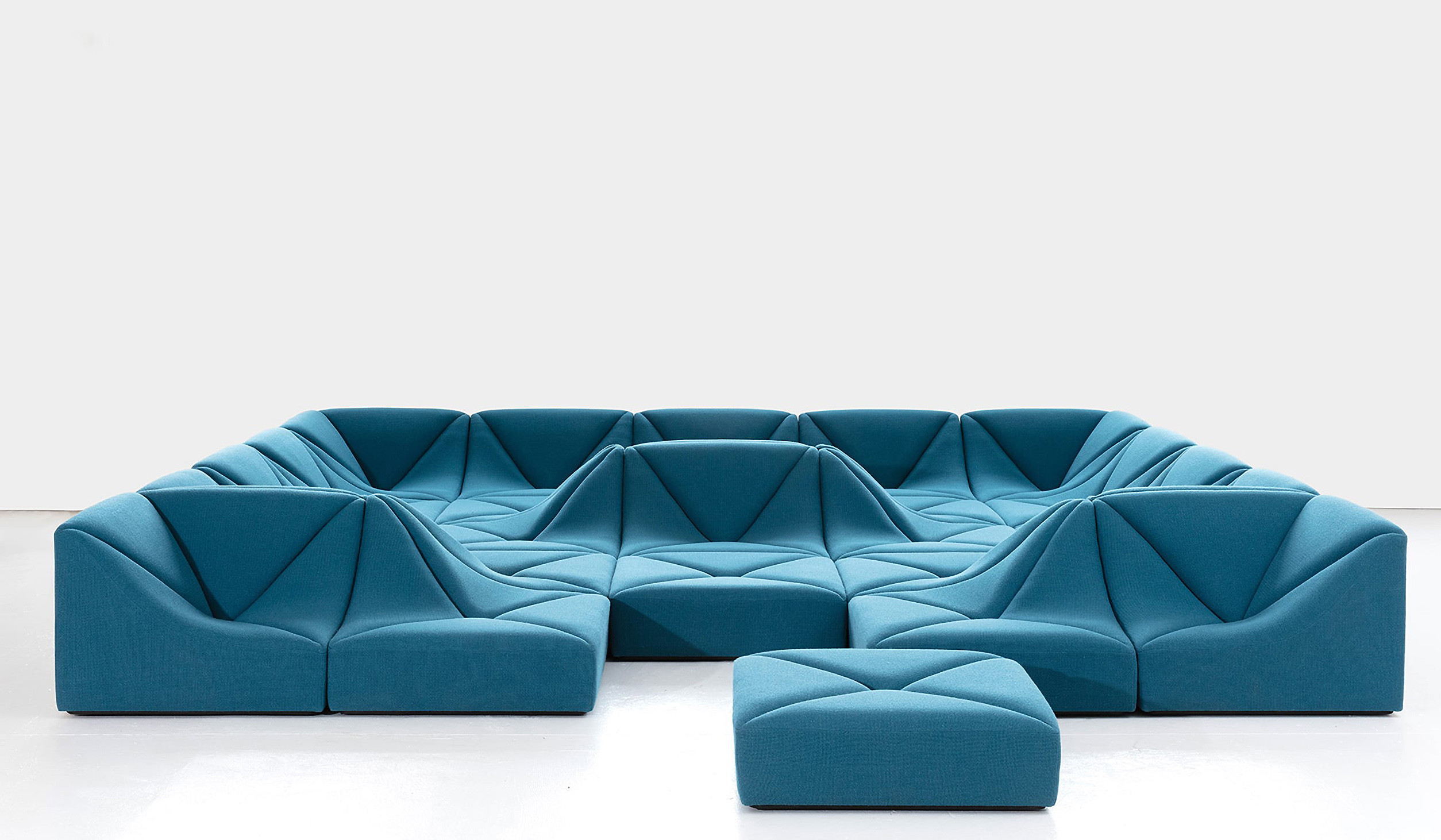

In the 1940s, “design” was not yet a term used in the furniture and interior industries. These fields were referred to as “decorative arts,” which is what the late Pierre Paulin, then a Picasso-trained sculptor, studied at the French Union of Modern Artists. There, he would join the first generation of industrial “designers” in France.
Hugely influenced by the likes of Florence Knoll and Herman Miller, Pierre quit school and pivoted from traditional furniture to more modern concepts informed by Scandinavian aesthetics. He focused on providing affordable, customizable furnishing solutions to a new generation of young people moving from the countryside to the cities. “There was absolutely a social mission,” says Benjamin Paulin, Pierre’s youngest son. “Everything had to be redeveloped and rethought.”
In 1968, nearly three decades into his career, Pierre created a modular flooring system he dubbed “the Dune” for its ability to undulate freely depending on how it was assembled. Some 50 years later, and a decade after Pierre passed away, the Dune would eventually gain new fame as “Frank Ocean’s couch.”
Contrary to what various Reddit threads and fan accounts may claim, the infamous photo of the elusive singer laying on the angular, mattressy teal sofa wasn’t taken at his apartment. The couch wasn’t his … yet. At the time, the blue Dune was a prototype kept by Benjamin Paulin at his Paris apartment, where his two young daughters had scribbled all over it. Frank was unfazed. “I told him I should make another one for him,” Benjamin recalls. “But he said, ‘No, this one.’”
Years after going viral via Frank’s Instagram photo, the Dune remains sought-after by taste-mongering celebrities from Pharrell Williams and Travis Scott to Stefon Diggs and Larry June. Its exclusivity earned itself the nickname “the Birkin of sofas.” There’s a bit of irony there, as its creator’s original intention was to foster community. But Benjamin’s hope is that Paulin Paulin Paulin is perceived as much a member’s club as a brand.
“The amazing thing is that sometimes, a life is not enough,” Benjamin says, referring to the renewed interest in his late father’s work. “Somehow our personalities and his work created something that connected to the new generation in a very unexpected way.”
As a former UMG recording artist, Benjamin has a deep connection to the music industry, especially hip-hop. “Growing up in the ’90s, rap culture was my university. It opened all the doors of the cultures of the whole world to me, so when I meet people like Travis, I’m super happy,” he says. “For me, it is not about selling a piece. They’re doing amazing things and I’m part of this history.”
Paulin Paulin Paulin—the company operated by Benjamin and his wife to produce Pierre’s archival pieces—refers to the family’s past, present, and future. While the context and environment of the pieces may change with time, the one constant is the design itself: “It’s important we don’t take any freedom with the intention and integrity of the design. We are only following the utopian ideas of my father,” Benjamin says.
We dissected the iconic elements of the Dune to understand what makes its design so enduring.
The Fabric
The conception of the Dune started with Pierre’s discovery of a wool and nylon-blend stretch fabric in 1957, commonly used in the swimsuit industry. As a trained sculptor, he became obsessed with the possibility of using the fabric to hide technical components, which are usually hidden somewhere in the back or bottom of furniture pieces. It was aligned with his philosophy of preserving the purity of a design. He put the stretch fabric over the Dune’s frame and cushioning as if it were a sock, a technique also deployed on his Mushroom and Tongue chairs.
The Skeleton
The frame of the Dune is made up of Bauhaus-style tubular steel commonly seen in postmodern desks and chairs. There are four different shapes for the building blocks that assemble and make up the Dune. Because of its modularity, the Dune varies in size, but the most well-known composition is 3.5 square meters, or approximately 11.5 square feet.
The Construction
The Dune is made by hand in the south of France from start to finish, by seven to nine people at a time at Paulin Paulin Paulin’s workshop. It is only made to order, and can only be purchased directly through Paulin Paulin Paulin.
The Price
According to various sources as of 2019, each Dune building piece is priced between $5,400 to $8,220—meaning Frank Ocean’s configuration would cost around $200,000. However, this is just an estimate, as Paulin Paulin Paulin does not work with third-party sellers for the Dune, and has never publicized its price—and also, Frank didn’t pay for his.
We spoke to Benjamin Paulin about the philosophy behind the Dune, his father’s legacy, and the unexpected cultural life the piece has taken on.
Pierre was adamant about being seen as a designer rather than an artist. What was his philosophy on industrial design and architecture versus art
My father was always telling me, an artist has to be a wolf. He has to obey no rules. He’s alone in front of everybody. A designer has to be a dog. He cannot be alone and pretend to be an artist, because his mission is to serve. He has to bring comfort and function. This is the clear difference between an artist and a designer in my father’s perspective. He was not seeing himself as a wolf, but as a dog, as someone who is serving the best way he can to improve people’s lives.
How does that philosophy extend to his creation of the Dune?
Totally. In the ’50s, Herman Miller developed a project called Action Office Program, which was designed to fill spaces with everything modular, so if they change the floor or the building, they could bring everything back and redeploy them. My father’s idea was to use this philosophy to adapt it to the residential market, inspired by Asian and Arabian culture of people living on the floor and having a big understanding of the art of being together. In his mind, the Dune was to be seen not as furniture, but as an articulation of the floor.
The brand has a strong connection to the music industry. Did Pierre also have an affinity toward music, and was that ever an element in his designs?
My father was into Bach and jazz. He never listened to music with words, like the Rolling Stones or Beatles. No interest. When I started to get into rap, it was a shock for him. It’s ironic; I don’t call our brand a “revival” because it never existed in his time, but part of this new era for my father’s design is a lot in thanks to rap music.
Do you think Pierre ever imagined or expected this to happen?
I don’t think so. But after he passed, I wanted to find a way to connect with him. I went to the archives and started to develop the interest to understand him as a designer. I grew up around the pieces my father tried to put into production, but were rejected. To me, they were the most important because they were the pieces of my youth, of my home, that nobody knew.
I was at a dinner with [late fashion designer] Azzedine Alaïa, and I didn’t know what to say to him. So I told him about my feeling of seeing my father’s piece in this museum exhibition. At the time, I didn’t have my daughters, and I thought if I have children one day, they won’t be able to experience these pieces. It was sad. Going back to your first question, is design supposed to be in a museum? Yes, it has to be celebrated, but you need the emotional experience to totally, fully understand the meaning.
And then [Azzedine said], “You will produce one for me so there will be one [piece outside] the museum.’ And so we made it, and also some tables. Thanks to Azzedine’s influence, [Louis Vuitton women’s creative director] Nicholas Ghesquière asked us to make sofas for his first Cruise show. Everything happened accidentally. No strategy, just passion and excitement.
I kept one of the prototypes, and one day Frank Ocean came to my place and was like, ‘I want it.’ He took this picture and then everybody wanted it.
What’s the backstory of Frank Ocean coming to your place?
My good friend Raquel, she’s a New Yorker, called me and said, ‘My friend Frank is in Paris and he’d like to meet you.’ She sent me his phone number and I was in the south of France so I said let’s meet in a few days, sent him my address and everything. But the discussion was not super clear so he immediately went to my place. Suddenly I received 20 messages on my phone like, ‘Frank Ocean is in the building. He’s looking for you.’ He was curious about what we were doing because of our project with Louis Vuitton.
A few weeks after that, he came to the apartment. My friend Raquel, who was there, took a picture of him that he posted. That was in my apartment. My daughters were very young, so there were a lot of pencil marks [on the Dune], it wasn’t perfectly clean. I told him I should make another one for him, but he said, ‘No, this one.’
Did he pay for it?
No, no. He took it. We had a discussion of course, but he was connected to this piece. You can feel that this person is very connected, very sensitive to everything. The way he can open up to the emotion means a lot to me. I feel this moment was very important for all of us.
Your apartment is currently set up as an artist’s residency in the form of a recording studio. What was the thought behind the “Sounds Like Paulin” project?
It started two months ago. Suddenly, we were connected to so many musicians. I thought, ‘Wouldn’t it be welcoming to have a studio at home so when our friends are in town, they can just come and record?’ We don’t ask anybody to pay anything.
They’re from different generations and genres so there’s the possibility of introducing all these people somehow. Don Toliver can meet a French singer from the ’80s who is culturally very important but totally unknown in America, and they’ll have a lot of things to discuss. There is nowhere in the world that they would meet except on the Paulin Paulin Paulin couch. I wanted to create a moment where it’s possible to traverse and exchange outside our algorithmic bubbles. [When] I discovered rap, rap opened me to every music, and now it’s the opposite. It’s difficult to go out of this bubble that auto-references itself. I wanted to create a multiverse that might one day influence culture.
What has been your most surprising collaboration?
I think Travis is an amazing person. Travis is one of the most hardworking people I know. It’s very rare to have this level of focus, and at the same time, let go when he’s on stage. I hope we’ll have a lot of things in the future. He’s a good artist and a very strong, strong artist. I don’t want to reveal anything private; I don’t have the right to say anything about Travis except that I have a lot of respect and admiration.
The Dune’s nickname is “the Birkin of sofas.” How do you feel about that?
When I was a teenager, my parents left Paris and were selling their apartment. Only once I was supposed to open the door for someone who wanted to see the apartment, and it was Jane Birkin [laughs].
Of course, the Birkin is the only actually valuable bag. To me, it’s a good comparison because it’s not just a trophy, it’s something significant as a valuable object for the future. What I want people to understand is that the Dune is not a trendy object. It’s supposed to stay. We only produce orders for our clients that we meet. There is no storage, no stock, no vintage. Sometimes people say, ‘Oh I have a vintage.’ There’s no such thing. The first one was produced in 2014. They’re lying.
You’ve caught people like that in real life?
Wiz Khalifa has a fake. Teyana Taylor has a fake. This horrible guy from the Kardashians, Scott Disick. You can say those three names. They should be ashamed. I told all of them, I will take back this fake and we’ll reduce the price by the amount you paid for the fake.
Scott Disick is a particular situation because he’s been asking me for a few years. He perfectly knew he was buying a fake. He bought it intentionally and even promoted the fake producer on his Instagram. Scott Disick is a very bad person. He wanted to kill my business. He wanted to redirect the millions of followers he has to the [fake] company. This is not very nice of him.
I don’t think Wiz Khalifa or Teyana Taylor are bad people. I think they were duped because they didn’t know when they bought it. But Scott Disick knew. If you don’t actually buy it from me personally, it’s a fake. There is no other way. The only way is to send an email to Paulin Paulin Paulin, to Paula or me. We are not working with shops or selling publicly.
How many real Dunes are out there?
I know the count but I cannot tell you. The first year we sold zero, then suddenly we sold one, then three, then five, then 10. It’s very irregular. We are like a little bakery. If you want a croissant, you go to the bakery and you buy it.
So the making process of the Dune is top-secret.
There are no secrets. We produce everything in the south of France. My father, at the end of the ’80s, discovered this wild area, not so far from Luma [arts center]. We are actually in the process of building a museum in the mountains there. We have seven to nine people working at the workshop, producing the pieces only on order. I would prefer not to [break down the making] because of the copies.
As you’re bringing your father’s designs from the ’60s and ’70s to life, how important is it for you to preserve his original ideas versus modifying them in any way?
We scrupulously maintain the original design. It’s very important that we don’t take any freedom with the intention and integrity of the design. A lot of my father’s designs were changed by the industry in the process of finding ways to produce it less expensively, for commercial reasons. Paulin Paulin Paulin has the opposite approach; we defend the design, whatever the cost. If it costs $100,000 to realize, then the price will follow, but this will be the production. We don’t care. We are only following the utopian ideas of my father, and our project is managed as a utopia. When I produce my father’s piece, it’s like producing a book. My interest is that people will have access to this book, and will tell the story.
Read the full article here


.jpg "Alix Earle and Tom Brady: A Timeline of the Dating Rumors")
