
Bronx-raised hairstylist Amoy Pitters brought Black salon culture to high fashion.
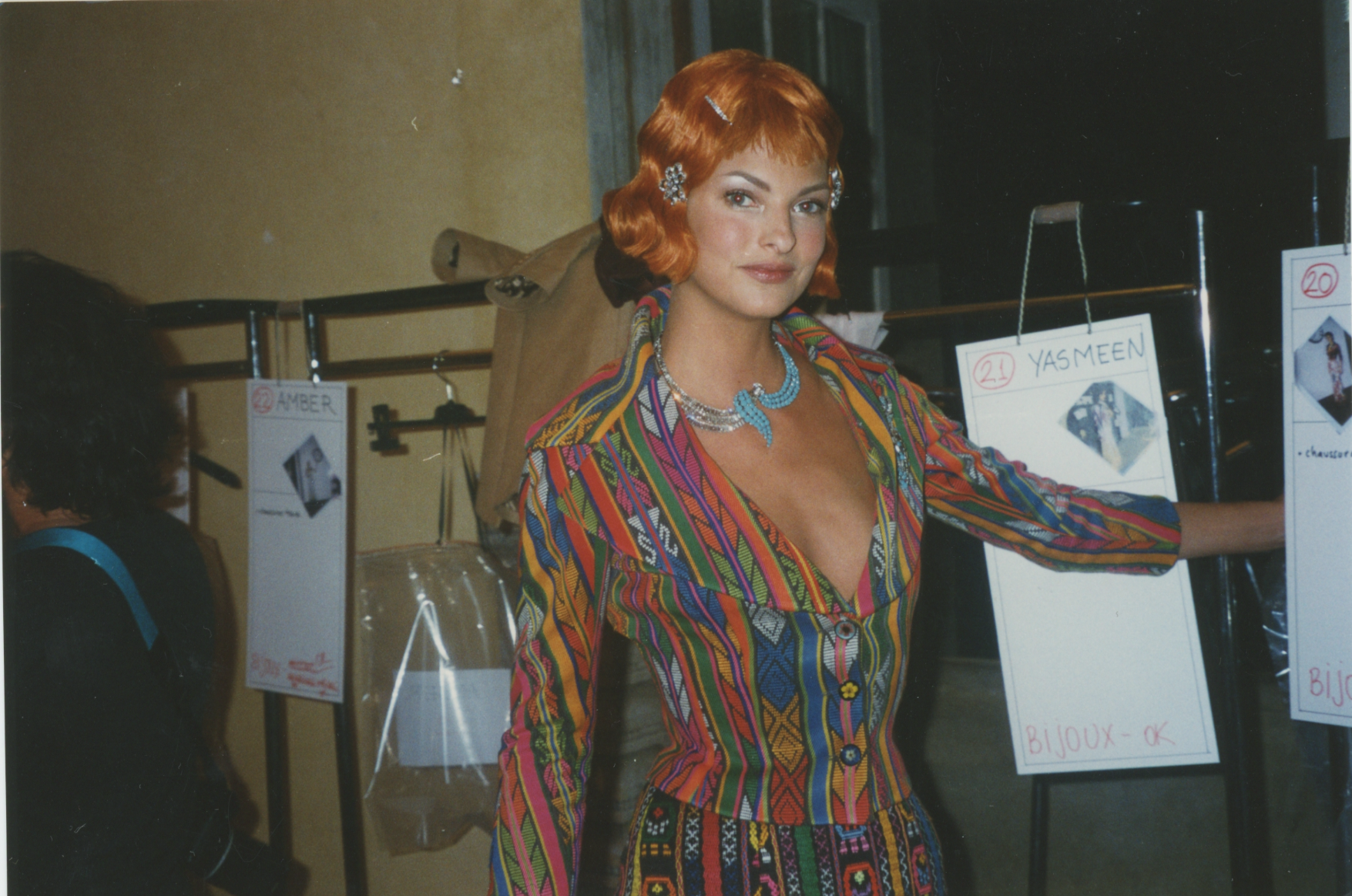
At just 22 years old, Pitters was recruited by renowned French hairstylist Odile Gilbert and editorial stylist Lisa Mitchell to craft Salvador Dalí-inspired multicolored fingerwaves on Dior’s Couture SS98 runway. “Coming from the Bronx in that era … I had it down pat,” Pitters says. She made a striking first impression, returning to Paris promptly as a part of Gilbert’s official team, and adding Milan, London, and countless other stops to the ticket across seasons. For those in the know, she became the best hands to book.
Nicknamed “Extension Girl,” Pitters introduced John Galliano to weave—including an extension dread collaboration with late hair icon Derek Scurry for Dior’s SS2000 show—and wowed Europe with her hair-first sew-in technique. “I changed the braiding pattern,” she shares. “I started braiding vertically and sewing horizontally, so when the hair grows out, it’s not pulling down.”
Her reputation caught Donatella Versace’s eye—who previously had sought-after hairstylist Ellin La Var on retainer—leading to weekly calls to Milan, Concorde flights, yacht stays, and even a Thanksgiving feast with Versace’s staff. Naomi Campbell spent 12 years devoted to (at least) monthly installs of Pitters’ famed weave work—including the bob she paired with a Dolce & Gabbana gown to do community service back in 2007.
While Pitters notes there weren’t many Black stylists working in high fashion at the time, her care and innovation expanded far beyond runways into music and film. She carved out space for Black artistry when the spaces provided were scarce.
We spoke to Pitters about how she got her start, her best haircare tips, and what it means to be the only “Extension Girl” on set.
Your family is originally from Jamaica, and you were raised in the Bronx. Can you talk about what it was like starting out in high fashion coming from that background?
When I got out of beauty school, there was an opportunity to work at a salon in the city. One of the stylists working there, Lisa Mitchell, I was her assistant. She was doing a lot of celebrities’ [hair].
After that salon closed down, I was doing a rented chair in the Bronx. [Lisa] got the opportunity to work with Odile [Gilbert], and she started going to Paris. [She] told me I had to come back to the city. I came back to work, and the opportunity came up to work with Odile, so I took it. I did a show with her here in New York, and she liked my work. She was like, “Do you want to come to Paris?” And I was like, hell yeah.
I went to my first show in Paris in 1996 or 1997. It was Christian Dior Couture in the summer. I had no idea what I was getting myself into.
What was it like working that show?
I just thought I was going there to carry this woman’s bag and help out on the floor. But I got there, and it’s this magical atelier. All the top girls were in the show: Naomi [Campbell], Kate Moss. They were doing finger waves for the show, and the theme was the ‘20s. It was Salvador Dali-inspired, with these beautiful multicolored wigs. Coming from the Bronx in that era, what did the girls wear? Finger waves. So I had it down pat. I was just busting out the wigs, and [the stylists] were like, “You know how to do this really well,” and I’m like, yeah, it’s just finger waves. On top of that, I’m working with stylists who are well-established and seasoned. I was the youngest person there, and I blew through my work.
Odile came and pulled me. I was like, oh, Lord, did I fuck up? She was like, “No, I want you to go and do the designer’s hair: John Galliano.” I had no idea that this was going to change my life.
At the end of it, [Odile] was like, “Would you like to come back?” I ended up just being a part of the team and running that whole circuit with her.
Can you talk about what it was like doing hair for John Galliano?
After that [first time], he really kind of fell in love with me. So I started putting extensions in his hair. There was one time when he had to have these long dreadlocks, so we put in extensions and made them into dreads. Derek [Scurry] and I worked on that together. He had no idea that he could get a weave, so I gave him a weave. That opened the door for Donatella Versace, because they went on vacation together. She was like, “My god, John, your hair grew so much.” And he was like, “Girl, this is not my hair. It’s a weave.”She called me, and I was like, “Who’s this?” and she was like, “It’s Donatella Versace.” She booked me right away to fly to Milan and do her hair.
What was your time working with Donatella like?
Oh my gosh, [she’s] so sweet. When I tell you that she’s probably one of the best celebrities that I’ve ever worked with, I mean it. This woman will literally give you the clothes off her back. Nothing but the best first-class travel. She flew me on the Concord twice, on private planes, and yachts. I had so many great experiences with her. When I was in Milan, I stayed at the best hotels and her driver would pick me up. You wouldn’t think that hair stylists would get treated like this, but the budgets that they had for us were insane. Just how respectable and how mannerable they were-I was just like, holy shit, these people really exist. You would never think that they would treat you so well.
[Donatella] gave me discounts in every Versace store in the world, and John was giving me ostrich Dior boots and saddle bags before they became a thing.
You were also then getting consistently requested by Naomi Campbell.
I worked with Naomi for 12 years. I met her at a show backstage, working with Odile. She took a liking to me and booked me to straighten her hair at a party. Then it turned into me doing her extensions, and [then] I started traveling with her, booking jobs with her. I would do all her campaigns, her perfume line, a lot of jobs with her in Brazil.
How did you maintain the health of her hair, considering that she’s booking show after show?
She would always have the weave, so her hair would be braided underneath. She would probably do her weave maybe once a month, but in between, if she came to New York, I would see her and wash it.
What was your favorite look that you did with her?
When she was doing the community service, and she had that short bob. That was one of my favorites.
It was a team effort. She wanted a change, and we were like, just cut it, just do something different.
Were there a lot of Black hairstylists around back then?
No, there weren’t. That’s why I was booked and busy because, aside from the fashion crowd, it rolled over into music, actresses, and actors—I was getting all of that.
What was the typical experience of having your hair done as a Black model, actress, or musician, if someone like yourself wasn’t on set?
It was tough. Before a lot of Blacks started showing up, they really couldn’t handle [their hair] as fast as we can, or they would put the wrong products. I was doing a show, they wanted the girl’s hair slick, and I watched a white stylist wet her hair down. I’m like, “No, you don’t want to wet that hair, it’s going to revert.” But when we came on the set, we got everybody, and not only were we doing all the Black girls, but then we had to do [all] the girls with curlier hair. Then the white girls started trusting us because they’re like, “Hey, what’s going on over there? I want to be a part of that.”Sometimes it was just Kate Moss, Shalom [Harlow], or Amber Valletta. So everybody did their thing backstage.
You were nicknamed the “Extension Girl,” but the way you talk about it, and also the way that I understand it, too, is you basically just came into this really white space with knowledge that just comes from your background.
Yes, exactly. That was just it; [that] and my talent. I love doing hair. So for me, I didn’t care who the person was. [Stylists were doing weaves] too tight, bulky, and not using good quality hair, the cut and the color were sometimes wrong… for me, it had to be seamless. I worked really hard to make sure that it looked natural. I started weaving my hair on myself, so once you practice it on yourself, you can get it to perfection on a client.
I changed the braiding pattern—I started braiding vertically and sewing horizontally so that when the hair grows out, it’s not pulling down. I made sure that the hair was well moisturized and conditioned before the person put in a weave, got their ends trimmed, did a nice treatment. If they get a relaxer, you make sure that’s not the part that’s left out, and that it’s not overrelaxed.
What were your favorite products to use back then?
I discovered René Furterer products in Paris, and I fell in love with them. And Lenore Grinnell. I think they were created for white hair, but they really worked nicely on our hair too because they were super moisturizing.
What was your favorite show that you worked on?
Jean Paul Gaultier was always my favorite. We did one where the girls had to mimic Frida Kahlo. They had thick eyebrows, and we had to create this big Spanish hair with the flowers in it.
What do you feel is the biggest lesson you’ve learned from your career?
Be yourself, stay grounded. Honestly, I didn’t really have a lot of bad experiences. I saw a lot of stylists lose themselves and their whole careers because they picked up a lot of bad habits. Just stay on top of your money. Make sure your invoices are paid, and make sure you’re getting paid value for your work. Not that the celebrities asked for free hair, but if they could have gotten away with it, they would.
Check out more of Pitters’ work in our special edition Headz zine, guest edited by Nikki Nelms, in Complex Magazine Issue No. 3. It’s available on Complex now.
Read the full article here